Advancing Vehicle Suspension Design: The Power of Automated Hardpoint Optimization
Traditional Genetic Algorithm approaches to suspension optimization struggle with a fundamental challenge: each optimization run takes approximately 15 hours and 1,500 simulations, yet all that computational knowledge disappears when targets change. Applus+ IDIADA's Automated Hardpoint Optimization service takes a different approach, using Particle Swarm Optimization with persistent surrogate modeling to reduce optimization cycles by 2-3× while maintaining accumulated learning across projects.
The Challenge of Suspension Hardpoint Optimization
Suspension hardpoint optimization is one of the most complex challenges in vehicle engineering. The position of each hardpoint—where suspension components attach to the vehicle chassis—has a profound impact on vehicle dynamics, ride comfort, handling characteristics, and overall performance. Traditional design methods, while effective, often require extensive iterative testing and can be time-consuming and resource-intensive.
The complexity arises from the highly nonlinear relationships between hardpoint positions and vehicle behavior. Multiple design objectives must be balanced simultaneously: ride comfort, handling precision, durability, packaging constraints, and manufacturing feasibility. This multi-objective optimization problem demands sophisticated computational approaches that can explore vast design spaces efficiently.
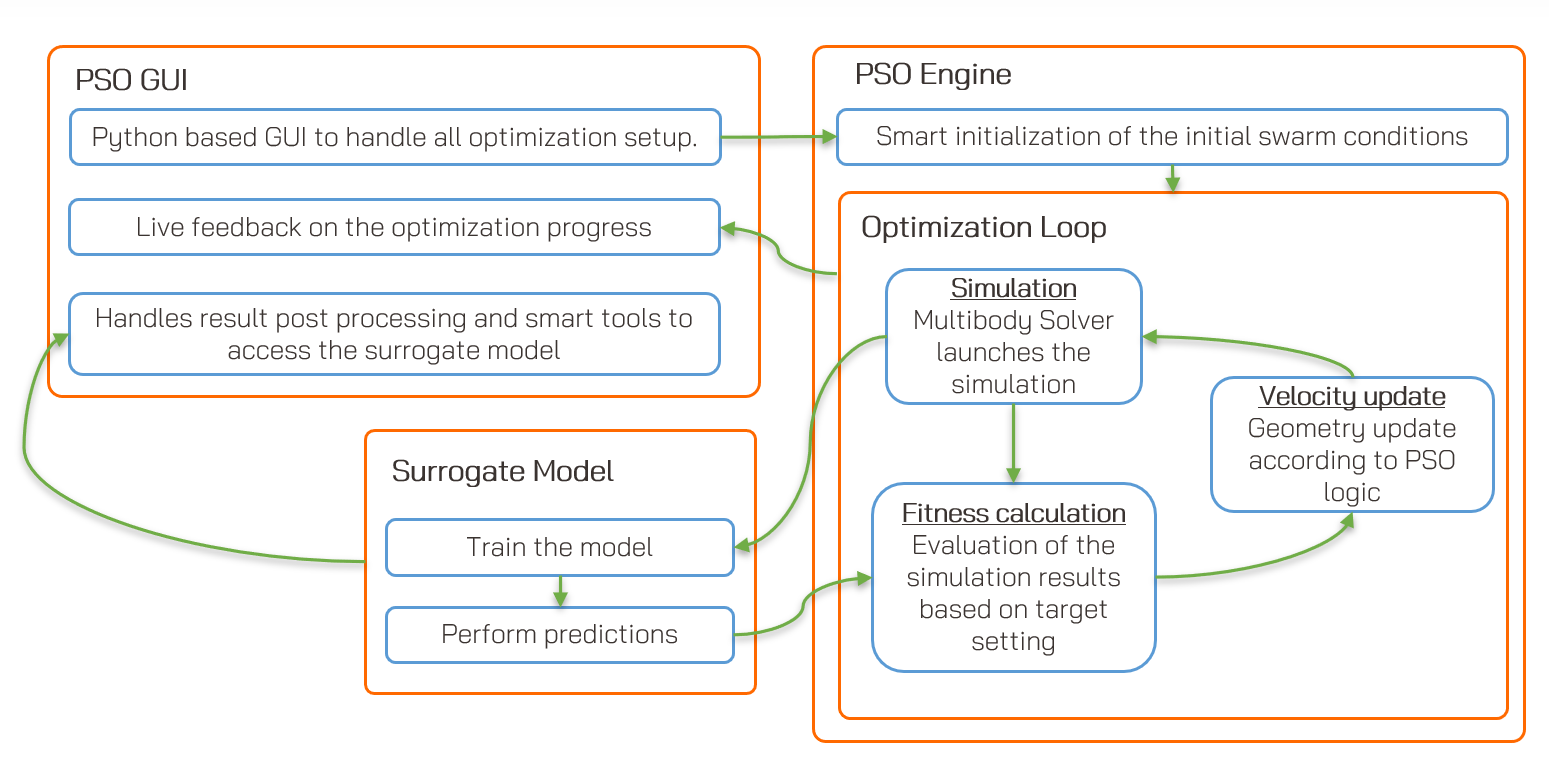
Particle Swarm Optimization: A Game-Changing Approach
Particle Swarm Optimization represents a significant advancement over traditional Genetic Algorithm approaches. Inspired by the social behavior of bird flocking and fish schooling, PSO employs a population of candidate solutions (particles) that move through the design space, influenced by their own experience and that of their neighbors.
Applus+ IDIADA's implementation of PSO for hardpoint optimization incorporates several cutting-edge innovations that significantly enhance performance:
Intelligent Particle Initialization
Rather than random initialization, our system uses smart seeding strategies based on engineering knowledge and previous successful designs. This approach reduces the search space and accelerates convergence to optimal solutions, cutting computational time substantially.
Dynamic Topology Management
The algorithm adapts its communication structure based on the complexity of the optimization problem. As the search progresses, particles adjust their interaction patterns to balance exploration of new design regions with exploitation of promising solutions already discovered.
Adaptive Parameter Tuning
PSO performance depends heavily on control parameters that govern particle behavior. Our system continuously adjusts these parameters during optimization, responding to the evolving search landscape to maintain optimal balance between global exploration and local refinement.
Stagnation Prevention Mechanisms
A common challenge in optimization algorithms is premature convergence, where the search process settles on suboptimal solutions. IDIADA's PSO implementation includes sophisticated mechanisms to detect and escape local optima, such as diversity monitoring, adaptive restart strategies, multi-swarm approaches or randomness control operators. These mechanisms ensure that the optimization process thoroughly explores the design space, maximizing the probability of finding truly optimal hardpoint configurations.
Surrogate Modeling with Artificial Neural Networks
One of the most significant innovations in our approach is the integration of surrogate modeling using artificial neural networks. Evaluating suspension performance through full vehicle simulations is computationally expensive. Our neural network models learn the relationship between hardpoint positions and performance metrics, enabling rapid evaluation of thousands of design candidates.
These surrogate models are continuously updated during the optimization process, refining their accuracy as more data becomes available. This adaptive learning approach ensures high-fidelity predictions while maintaining computational efficiency, a critical balance for practical engineering applications.
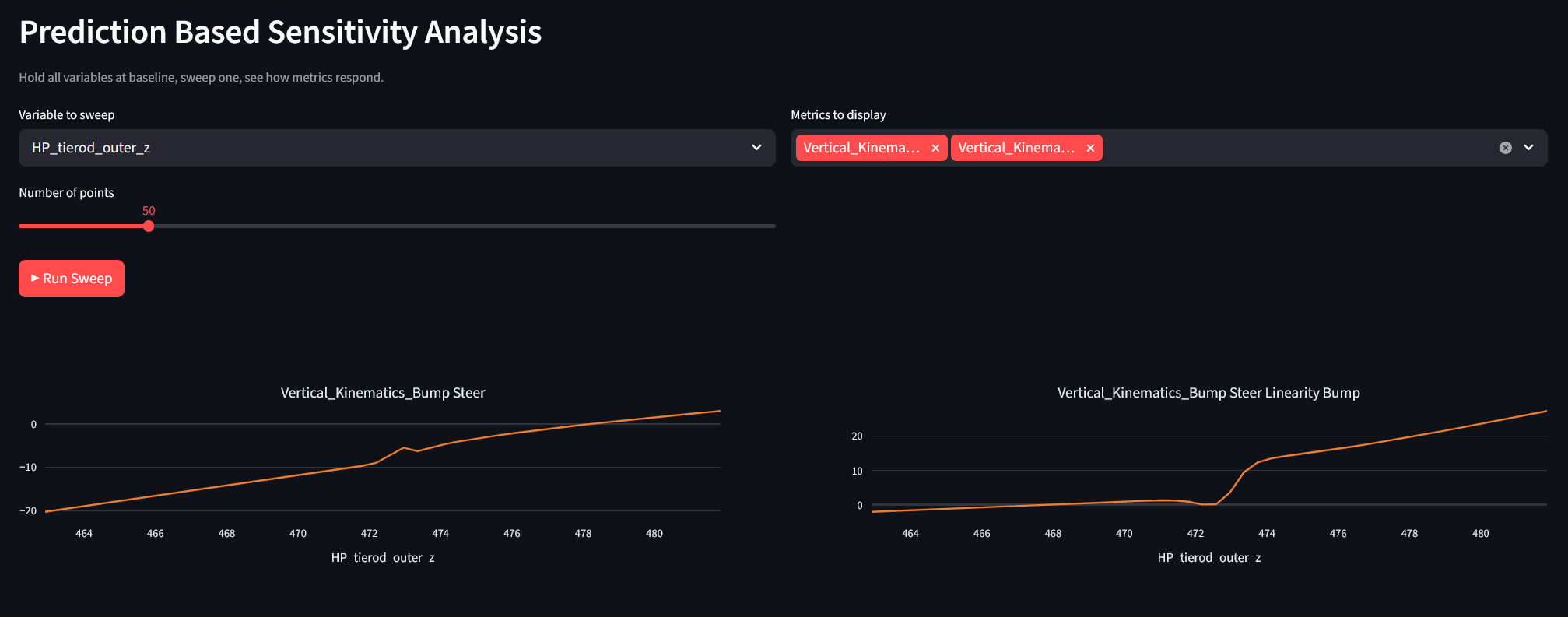
Additionally, the workflow includes a GUI that allows the user to access the trained model and perform experiments without the need of performing simulations. This implementation allows us to further optimize the use of the information we obtain during the process.
Curve-Based Optimization for Enhanced Precision
Beyond individual hardpoint positions, our service optimizes entire performance curves such as wheel rate progression, camber curves, and anti-dive characteristics. This curve-based approach ensures that suspension behavior is optimized across the full range of vehicle operation, not just at discrete design points. This means that by setting as target a complete set of curves obtained with real testing data, we can virtually replicate a suspension’s behavior from scratch.
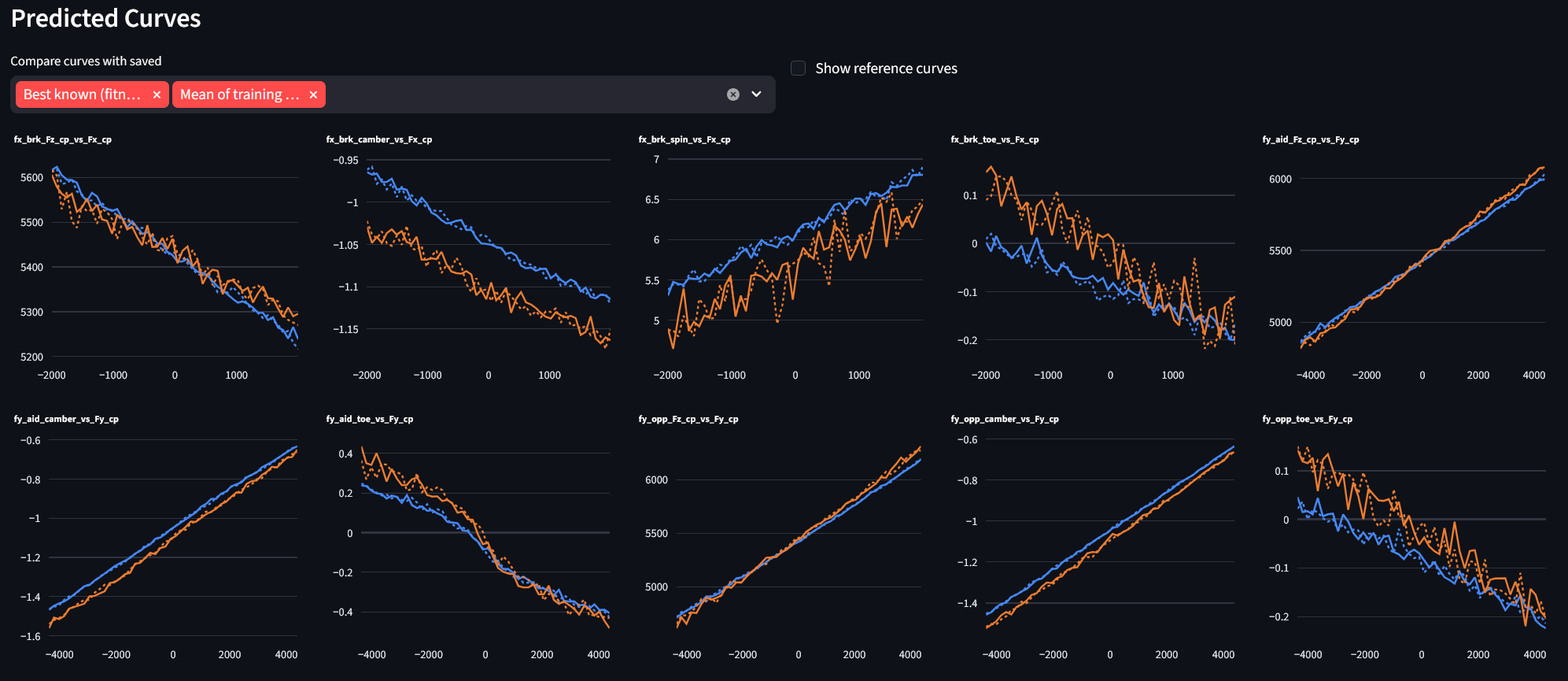
By representing curves as mathematical functions with optimizable parameters, we achieve smoother, more predictable suspension characteristics that translate directly to superior vehicle performance in real-world conditions.
Real-World Benefits and Applications
The advantages of Applus+ IDIADA's Automated Hardpoint Optimization extend across the vehicle development process:
Reduced Development Time
Our optimized PSO approach delivers high-quality solutions in significantly less time than traditional methods, accelerating time-to-market for new vehicle programs.
Superior Performance
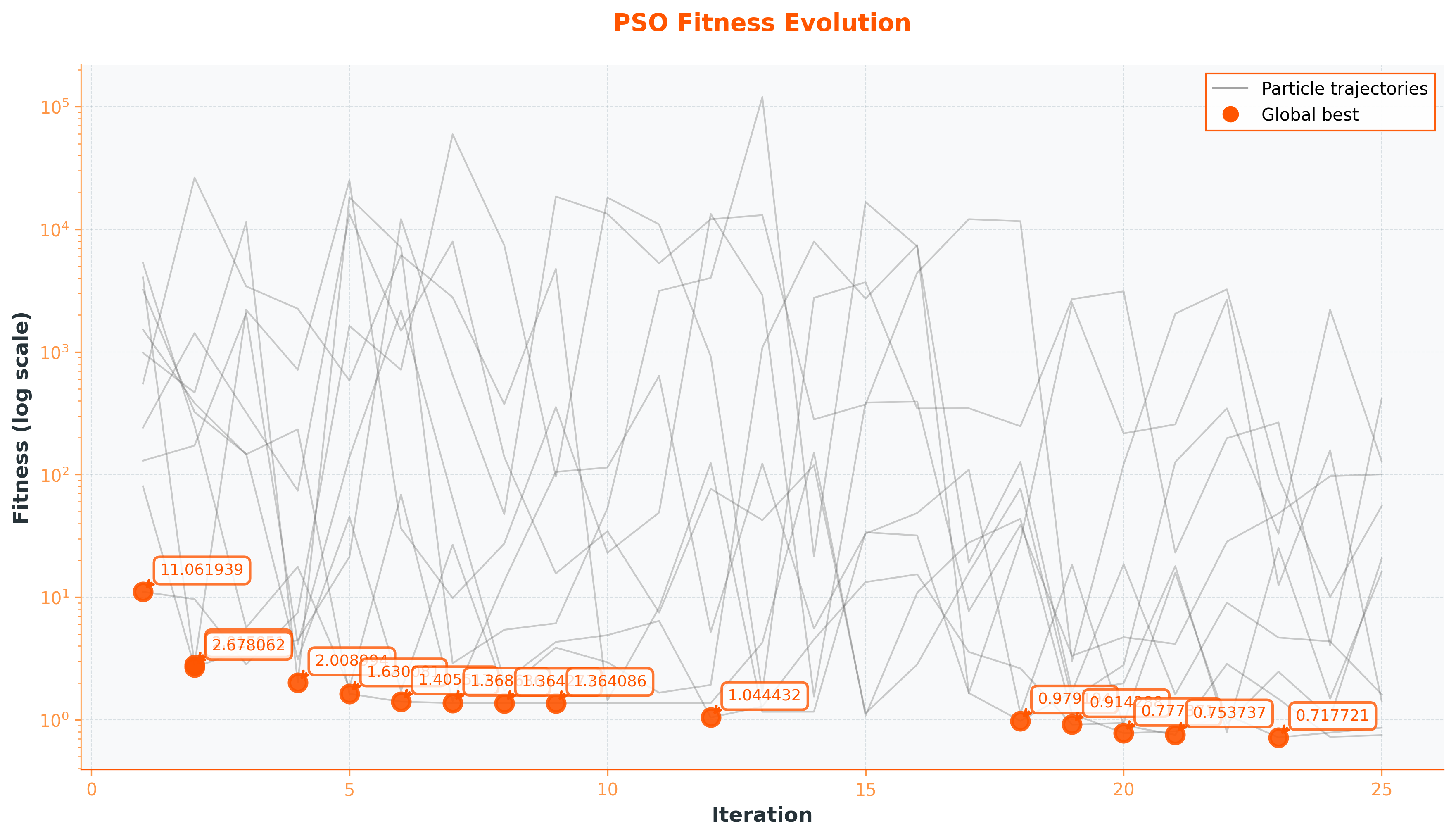
The sophistication of our algorithms consistently produces suspension designs that outperform those generated by conventional Genetic Algorithm approaches, with measurable improvements in ride quality, handling, and durability coupled with a faster convergence.
Engineering Insight
The optimization process generates valuable data about design sensitivities and trade-offs, providing engineers with deeper understanding of suspension behavior and informing decision-making beyond the immediate optimization task.
Flexibility and Adaptability
Our service accommodates diverse vehicle types, from passenger cars to commercial vehicles, and can optimize for custom objectives specific to each project's requirements.
What’s next
Suspension design keeps getting more complex, and development schedules aren’t getting any easier. The optimization tools automotive engineers use need to keep up. This system does three things well:
- It runs 2-3× faster than traditional methods
- It remembers what it learned from previous projects
- It lets engineers change targets without starting over
That's useful when working against tight deadlines.
The persistent surrogate model means the knowledge from the last optimization doesn’t disappear. The next run starts with that accumulated understanding already in place. It’s not magic, it’s just better use of the computational work already done. For teams optimizing suspension systems, whether on new EV platforms or existing architectures, this translates to fewer hours waiting for results and more time making engineering decisions.
The power of this tool lies in the optimization engine and the communication with the artificial neural network, so our team is working to implement this algorithm beyond suspension optimization. Wondering how this approach could fit your next project? Let’s start the conversation.